
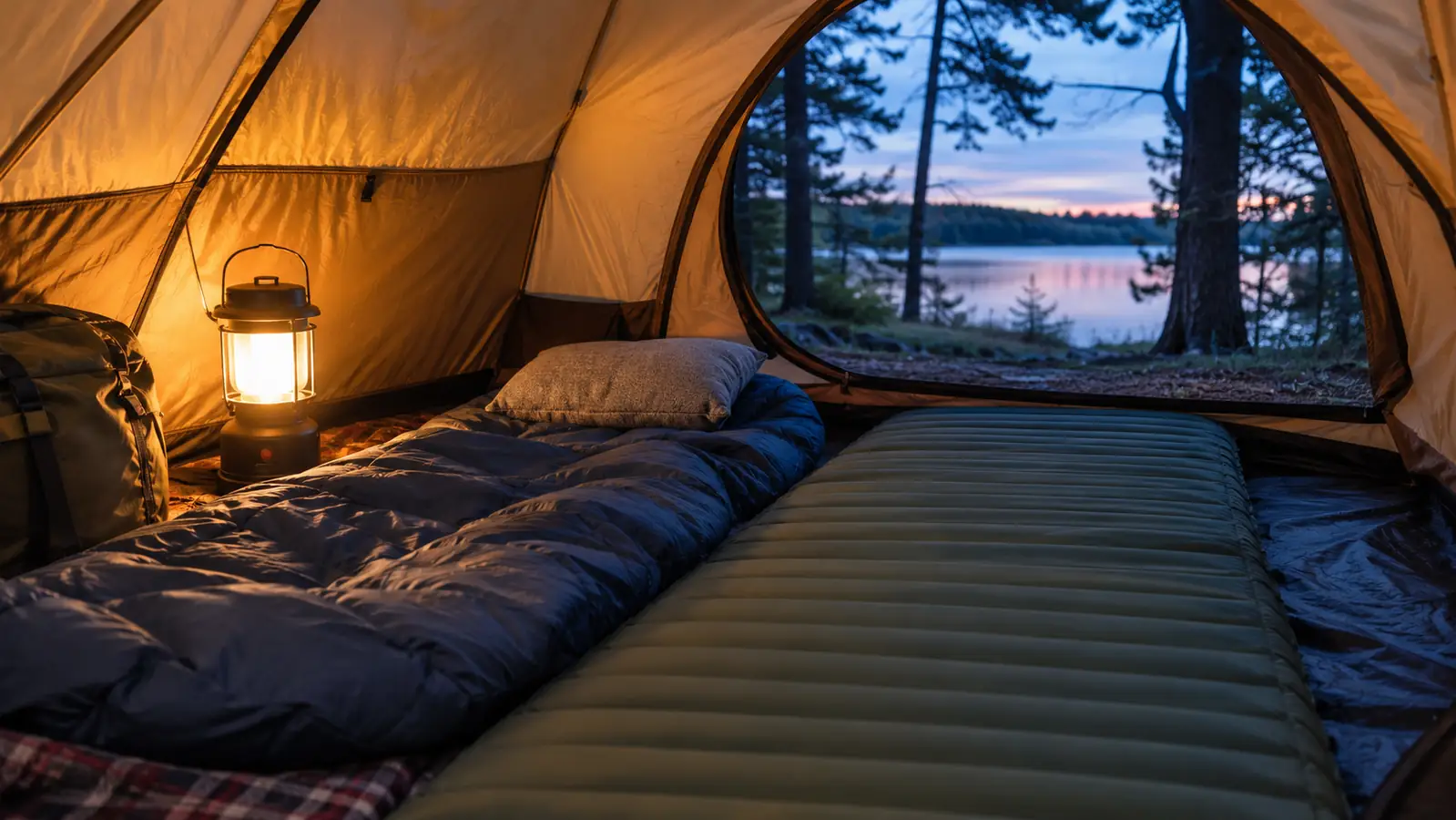
Juniper wakes me at 4:40 in the morning because she has wedged herself into the small of my back, which means the pad has gone cold under her. It is 34 degrees at a state park outside Shelton and the cold coming through the tent floor is not air. It is the ground, pulling warmth out of me all night like a drain I cannot close. I have camped most weekends from April to October for years, and the temperature on the weather report is never the number that decides how I sleep. The number that decides is what my sleeping pad gives back.
For years I thought the answer was more padding. I bought a thick air mattress that felt like a pool toy and froze on it worse than on the thin foam pad I started with. A plain air mattress has nothing inside to hold warmth. You are sleeping on a bag of moving cold air, and moving air carries your body heat down to the tent floor and leaves it there. What changed my nights was the Gear Doctors Oxylus, a self inflating pad with actual foam inside, and then about five habits I had to learn the hard way. The pad is half the answer. The other half is what you do in the twenty minutes before you get into it.
The half of the problem you actually solve with money
The Gear Doctors Oxylus is a self inflating pad with a 4.3 R-value foam core, 1.5 inches thick, 72 by 22 inches, 2.2 pounds. It will not fix a cold night on its own. It is the piece you cannot improvise.
Amazon Check Today's Price on Amazon →Step 1: Put Something Real Between You and the Ground
An R-value measures how hard it is for heat to move through a material, and it is the only number on a sleeping pad listing that tells you anything about warmth. A pad under 2 is a summer pad. Somewhere between 3 and 5 is a three-season pad, which is what most of us in the Northwest actually need, since a July night at elevation can drop into the low forties without warning. The Gear Doctors Oxylus runs a 4.3 R-value foam core at 1.5 inches thick, and that combination is the whole reason it works. The foam is not there to be soft. The foam is there to hold still.
Air moves. Foam does not. That is the entire difference between a pad you can sleep on in April and one you cannot. When I lie down on the Oxylus, my hip does not find the ground and the ground does not find me. It is rectangular, 72 inches long and 22 inches wide, and the width matters more than I expected, because the tapered pads I used to own narrowed at exactly the spot where my elbows want to be.
Juniper is forty two pounds of Australian cattle dog mix who believes the pad is hers and that I am a guest on it. She has walked across it with muddy feet and turned around on it three times before lying down, and the surface has held up. The pad carries up to 250 pounds, which is plenty for me and a dog who has decided to be a lap. The carry bag also has a repair patch in it, and I now leave that patch in the bag rather than in a drawer at home, because the puncture never happens in the driveway.
Step 2: Inflate It in the Tent, Then Top It Off
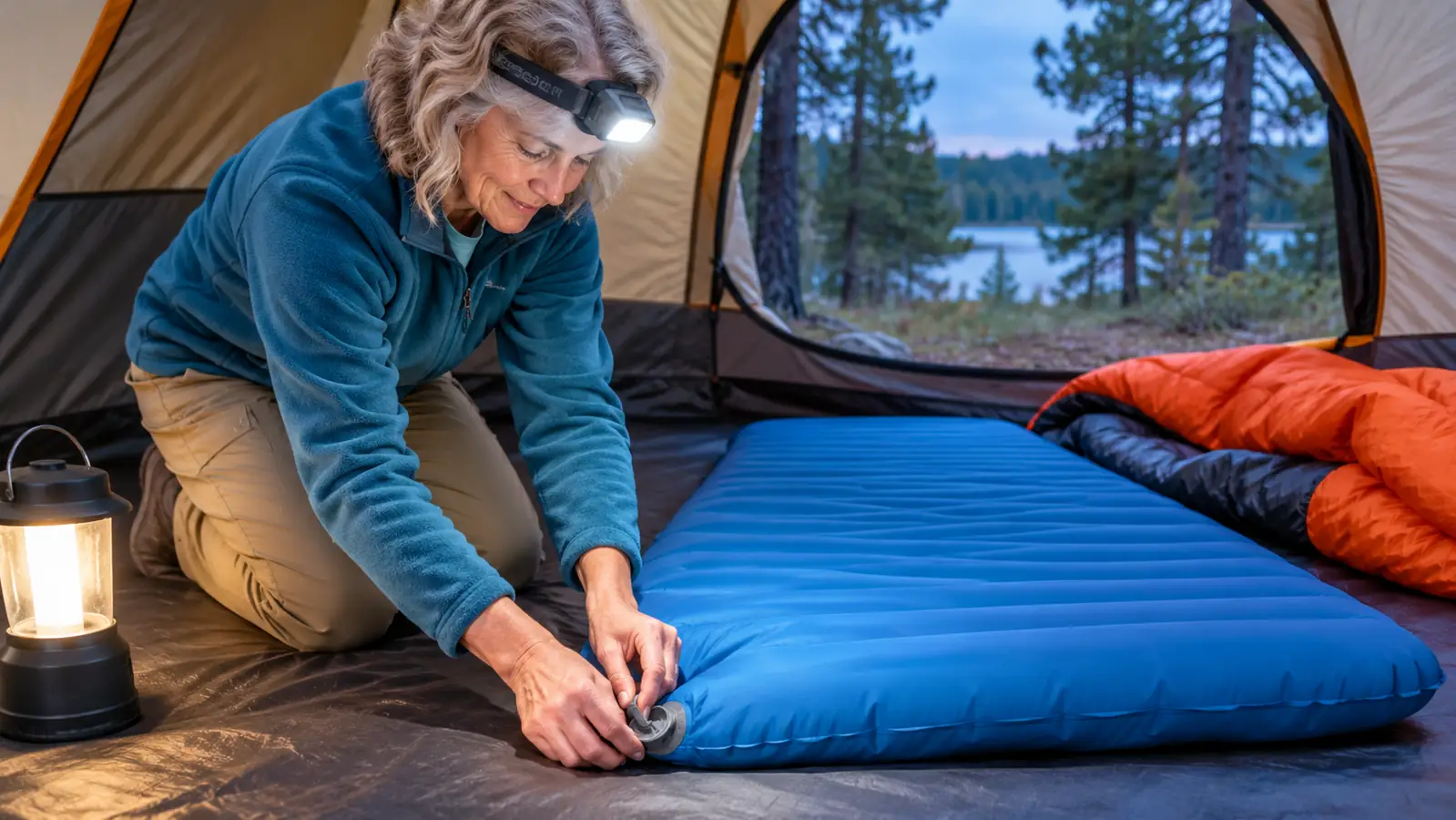
A self inflating pad has open cell foam inside that wants to expand. You unroll it, open the valve, and the foam pulls air in on its own. Gear Doctors lists pack to sleep ready in under five minutes, and that has been about right for me, but the five minutes only count if you spend them in the right place. I open the valve and let it breathe inside the tent, not out on the picnic table. Air that goes in at 65 degrees is not the air you want inside the pad at 38.
Here is the part that took me two seasons to figure out. Air contracts as it cools. A pad that feels perfectly firm when you fill it at seven in the evening will feel soft and vague by two in the morning, because the air inside has shrunk and the foam is carrying you alone. So I inflate, let it sit, close the valve, then add two or three breaths through the valve before I close it for the night. Not more. The Oxylus is a medium firmness pad, and if you blow it up hard as a drum you have turned a foam pad into an air mattress and lost the thing you came for.
The valve is the whole system on a pad like this, so treat it that way. Close it fully. If you can hear a faint hiss at midnight, you will be on the ground by four, and it will not be the pad's fault. I check mine with the back of my hand after I close it, because the back of my hand notices a leak before my ears do.
Step 3: Insulate Above You as Deliberately as Below
Every sleeping bag temperature rating you have ever read assumes you are lying on a pad with a decent R-value. Put a bag rated for 20 degrees on a bare air mattress and you are sleeping in a 45-degree bag, no matter what the label says. This is why people keep buying warmer and warmer bags and still shiver. The bag is not the problem. The bag is doing its job. The heat is leaving from underneath, where there is nothing to stop it. Once I had a real pad under me, my old bag started behaving like the bag on the label and I stopped shopping for a new one.
Above you, the rules are simpler and cheaper. Wear a dry hat. Wear dry socks, and change into them right before bed even if the pair you had on all day feels fine, because it is not fine, it is damp. Keep a fleece or a wool layer on that you would not sit around a fire in. If your bag has a hood, use the hood. It is not decorative. Your head is a radiator and you can turn it down.
One thing not to do: do not breathe into your bag to warm it up. It feels good for about ninety seconds, and then you have put a cup of water vapor into the insulation, and wet insulation does not insulate. If you are cold, sit up, move around for twenty seconds, and get back in. Your own body is a better heater than your breath.
Step 4: Get the Moisture Out Before You Lie Down
Everything you bring into a tent puts moisture into the air. You do. The dog does. The wet boots by the door do. On a cold night that moisture condenses on the coldest surface it can find, which is often the inside of the tent wall and sometimes the top of your bag. So the last ten minutes before bed at our site are not about warmth at all. They are about removing water.
Juniper gets toweled off every night, whether she looks wet or not, because her coat holds a surprising amount and she is going to be on the pad with me. Boots and the day's socks go into the vestibule, not into the tent. Anything damp gets hung from the loop at the top of the tent instead of piled in a corner. And at home the pad comes out of the carry bag and gets stored flat with the valve open, because a self inflating pad that lives compressed in a sack for eight months is a pad that has forgotten how to expand. I learned that with an earlier pad. I am not repeating it with this one.
Step 5: Handle the Dog, the Door, and the Cold Air
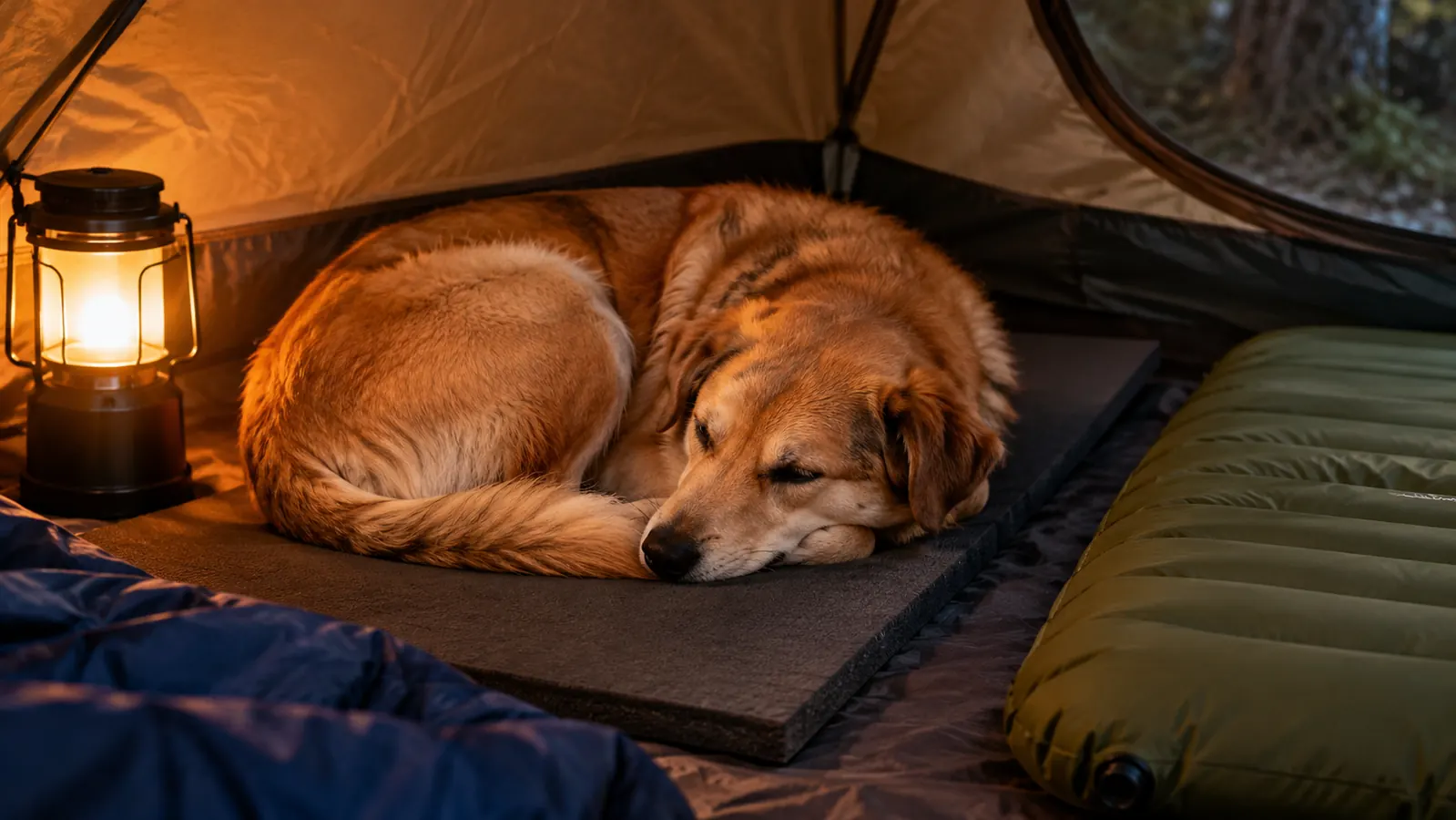
Two warm bodies in a small tent make a real difference, and one of those bodies is a dog. Juniper sleeps against my legs and I am not going to pretend I mind. But a dog lying on a pad compresses the insulation where she lies, so she gets her own thin foam square next to the pad and she uses it about half the time. The other half she is on mine. The 22 inch width and the 250 pound capacity mean she is not shoving me off, which is more than I could say for the narrow pad I owned before this one.
The door is the other thing. Every trip out of the tent at night dumps the warm air you spent an hour building. Glenn is up at least once and so am I. What helped was putting the pad and the bags on the side of the tent away from the door, so the cold air that comes in when the zipper opens has to cross the whole floor before it reaches us. That sounds like a small adjustment. On a 34 degree night it is not small. It also keeps the dog from bolting past a pair of legs at two in the morning.
Leave one vent cracked high on the tent. I know that sounds wrong on a cold night, but a sealed tent collects condensation all night and you will wake up with a damp bag and a damp dog, and damp is colder than cold. A small high vent lets the moisture out and lets very little of your warmth go with it. Two people and a cattle dog in a closed tent is a lot of water vapor.
What Else Helps
Site selection does more than most people give it credit for. Bare rock, concrete pads and packed dirt pull heat out of a tent floor faster than grass, duff or pine needles. When we have a choice at a state park, I take the site with the softer ground even if it is a little further from the bathroom. A footprint or a tarp under the tent adds a layer and keeps the floor dry, which matters more than how thick the tarp is.
Eat something before bed. Not a lot, but something with some fat in it, because digestion is a furnace and you might as well run it while you sleep. A hot drink helps too, mostly because it is a hot thing in your hands. If you want the old trick, fill a water bottle with hot water, put it inside a wool sock, and shove it down to the foot of the bag twenty minutes before you get in. It works. So does putting tomorrow's clothes at the bottom of the bag, so you are not dressing in cold fabric at six in the morning.
And be honest about the pad you already own. If it is a thin air mattress from a gas station, no amount of layering is going to get you through a night in the forties, and the money is better spent on a pad with real insulation in it than on a warmer bag. I would rather have the Gear Doctors Oxylus and my old bag than a new bag and a pool toy.
A sleeping bag's temperature rating is a promise made on the assumption that your pad is doing its job. The pad is the part you actually control.
None of this is complicated and none of it costs much beyond the pad itself. The order matters: separate yourself from the ground, inflate it properly and top it off, insulate above you, get the moisture out, then keep the cold air at the door. Do those five things and 34 degrees stops being a night you endure and becomes a night you sleep through. Juniper will still take the warm side. That part is not negotiable.
Start with the layer that decides everything above it
Gear Doctors Oxylus: self inflating, 4.3 R-value foam core, 1.5 inches thick, 72 by 22 inches, 2.2 pounds, carry bag and repair patch included. A three-season pad for people who camp in a real Northwest spring.
Amazon Check Today's Price on Amazon →