
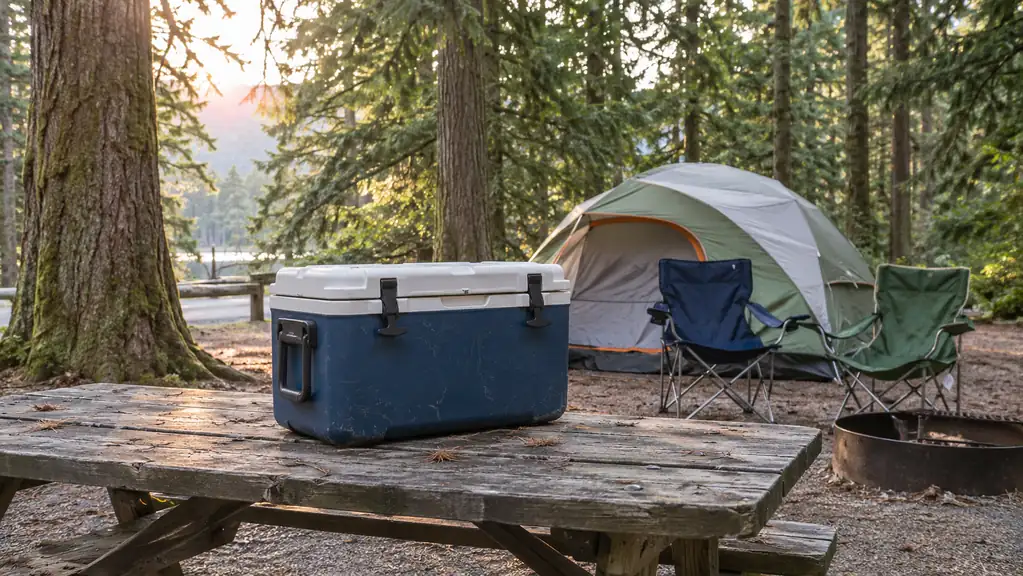
The short answer is that the Igloo Trailmate keeps ice longer, and after three days in July shade it was not close. I put the same 20 pounds of cubed ice into the Trailmate and into a soft-sided cooler bag of roughly the same outside size, set both within four feet of each other under the same cedar at a state park west of Olympia, and opened them at the same three times a day. By Saturday afternoon the soft bag was holding cold water and two floating cubes. On Sunday morning the Igloo still had solid ice in the bottom, and the cans underneath it were cold enough that Glenn mentioned it twice.
That is one column in the comparison, not the whole table. Most of us are not carrying a cooler on our backs. We are lifting it out of a car, setting it on a picnic table, and lifting it back in two days later with a wet towel and a bag of softening lettuce on top of it. Glenn and I camp most weekends from April through October, mostly drive-in sites and state parks, and Juniper, our cattle dog mix, insists on being first into the back of the Outback every single time. The cooler that survives that routine is not automatically the one that holds ice longest, so I kept notes on both and I am giving you all of them, including the places where the soft bag wins.
| Igloo Trailmate (50 qt) | Soft-sided cooler bag | |
|---|---|---|
| Capacity | 50 quarts, which the listing puts at 81 cans | Usually 24 to 30 cans in a bag you can carry with one hand |
| Ice retention | 1.5-inch foam walls and an insulated lid; solid ice into the third morning | Cold water and floating cubes by the second afternoon |
| Empty weight | 15.4 pounds before you put anything in it | A fraction of that, and it folds down flat in the garage |
| Carrying it any real distance | Wide side handles with a reinforced crossbar and a diamond-textured grip, but loaded it is a two-hand carry | Shoulder strap, one hand free for the leash and the gate latch |
| Fitting into a loaded car | 18 by 25.7 by 16.7 inches, so it owns a corner of the cargo area | Slides behind a seat and squashes into whatever gap is left |
| Sitting on hot ground | Cool Riser Technology lifts the body away from hot surfaces | Sits flat on whatever is under it |
| Claws, gravel and firewood | Hard shell, made in the USA with USA and imported parts | Fabric and a coated liner; the last one did not survive my dog |
| Cleaning at the end of the trip | Wipe it out with a cloth and leave the lid open on the porch to air | Has to be turned out and hung properly or it smells like last August |
| Best for | A camp you drive into and stay at | A day out where you carry everything yourself |
How I Tested Both Coolers
I did not run a lab test, because I do not have a lab. I ran the test I actually have, which is a Friday to Sunday at Millersylvania in July, on a shaded site with a picnic table that has seen better decades. Both coolers got 20 pounds of cubed ice from the same bag, both started with a chilled interior, and both stayed shut except for the three times a day I opened them to move things around and look.
The second test decided more than the first one did. I loaded the car the way I load it for real: camp box, two folding chairs, tent bag, dog bed, water jug, cooler. Then I unloaded it and did the whole thing again with the other cooler. I counted the trips from the car to the table and the number of times I had to move something to make room. That is not fussy bookkeeping. It is the difference between twenty minutes of setup and forty, and at fifty-eight with one shoulder that clicks, forty is a long time.
One thing worth saying plainly: I have no stake in which one you buy. I bought the Trailmate because a friend's cooler held ice through a hot week and I am suggestible about that sort of thing. What follows comes from what I saw, plus the specifications Igloo publishes, which I checked rather than trusted to memory.
What Three Days of Ice Actually Looked Like
Friday afternoon both coolers got their ice and a six-pack of cans on top. At the twelve-hour mark they were tied, which is what you would expect from two insulated boxes sitting in the same shade. Saturday morning the soft bag was giving ground: the ice had dropped by half and the meltwater was up over the cans. The Trailmate still had most of its cubes and only a little water in the bottom.
I should say what the weather did, because it explains the result better than anything else I can tell you. Friday topped out at 89 degrees at the site, Saturday at 84, and Saturday night dropped to 51, which is an ordinary July for us and cooler than the summer we had in 2021. Both coolers sat in the same band of shade from the same cedar, so neither one got a break the other did not get. The one variable I introduced myself was opening. Three times a day, both lids, about ninety seconds each, and I did it for the same reason both times, which is that I wanted to look. On the trip before this one I left the soft bag shut for a full day to see whether that would save it. It did not. It bought maybe two hours, not a day.
By Saturday evening the soft bag had no ice at all. The water inside was still cold, and in fairness, cold water will keep a package of hot dogs safe overnight. But cold water is not ice, and when you open a lid on Sunday morning to make coffee, you are not measuring cold. You are looking for cubes. The Igloo had them. That is the whole argument and it is not a close one, which is exactly why the rest of this comparison needs to exist.
Cold water will keep a package of hot dogs safe overnight. Cold water is not ice. On Sunday morning I was looking for cubes, and the Igloo had them.
Where the Igloo Trailmate Wins
The insulation is the reason. Igloo builds this one with 1.5-inch foam in the walls and an insulated lid, and the body sits on what the company calls Cool Riser Technology, which lifts it off hot surfaces instead of letting the ground pull the cold out of the bottom. At a campsite where the picnic table has been in the sun since ten in the morning, that matters more than it sounds like it should. A cooler sitting flat on hot concrete is losing ground all afternoon while you are off walking the dog.
What I noticed by the second morning was how little the opening cost it. A hard cooler with a thick lid gives up cold air slowly and gets back to temperature fast, and the Trailmate got back to temperature fast enough that I stopped thinking about it somewhere around Saturday lunch. I also stopped worrying about what was sitting on top of it. On Saturday I set a cast iron skillet down on the lid while I moved the camp box out of the way, and the lid did what a hard lid does, which is nothing at all. The soft bag in that same moment had a jacket piled on it, and I had to move the jacket before I could get at the zipper. Small thing. It happened six times over the weekend.
The second win is that it is a hard shell and it does not care what happens to it. Juniper stands on the lid. Firewood gets stacked against the side. It rides home with a wet towel inside and gravel in the bottom, and I wipe it out with a cloth and leave the lid open on the porch to air. Fifty quarts is 81 cans by the listing, which is more than two people need, and that extra room is what lets me put a real block of ice in the bottom and food on top of it. Fifteen and a half pounds empty is light for something this size, and the side handles are wide with a reinforced crossbar and a diamond-textured grip, so a loaded carry across a parking pad is not the punishment you would brace for.
Where the Soft Cooler Wins
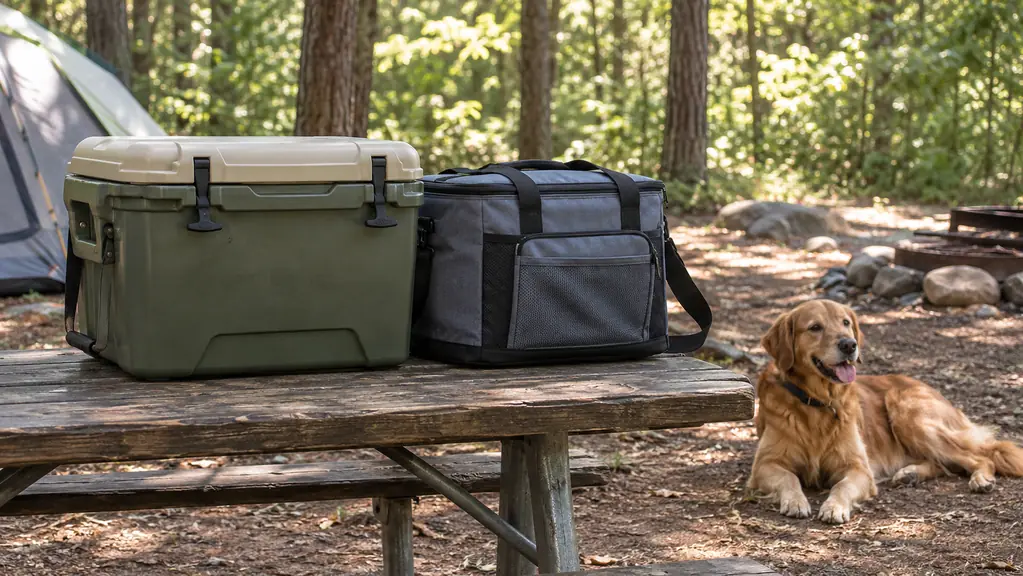
Weight and hands. The soft bag weighs a fraction of what the Trailmate weighs, and it has a shoulder strap, which means I can carry it in one hand with the leash in the other and still get the gate open. From the parking pad at some of these sites to the actual table is a hundred yards over roots and gravel. That is a two-trip job with a loaded hard cooler and a one-trip job with a bag, and on a hot afternoon in August that difference is the whole afternoon.
The site that settled this for me was a walk-in at Schafer State Park, where the parking really is a hundred and twenty yards from the table, over roots and down a slope with a switchback in it. I counted the yards on the way back for the water jug, which tells you how the afternoon was going. With the soft bag it was one trip, leash looped over my wrist, and I was sitting down before Glenn had the tent out of its bag. With the Trailmate loaded it was three trips and a rest on the tailgate in the middle of them. I am not complaining about three trips. I am telling you that at eighty-four degrees the number of trips is a real cost, and it belongs in the decision alongside the ice.
It also fits where the Trailmate will not. The Igloo measures 18 by 25.7 by 16.7 inches, and in a 2017 Outback with a dog bed and a tent bag already back there, it owns a corner. The soft bag slides behind a seat, squashes into a gap, and folds flat against the garage wall between trips. If you are packing for a day at the lake rather than a weekend, it is the sane choice, and I still keep one for exactly that.
If you want ice on Sunday morning, this is the cooler that still had it
The Igloo Trailmate holds 50 quarts, weighs 15.4 pounds empty, and kept solid ice through three days of July shade. If your camp is one you drive into and stay at, that is the entire job.
Amazon Check Today's Price on Amazon →Packing Both Into a Subaru Outback With a Dog
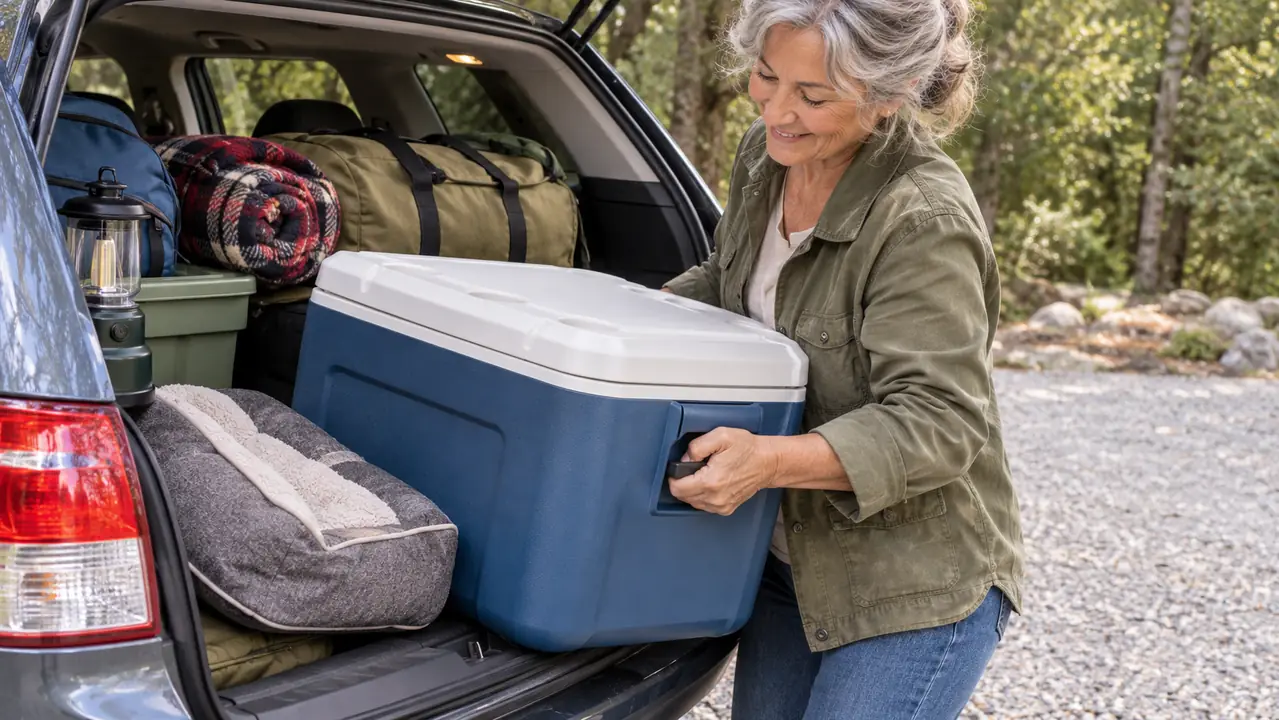
Here is what the back of the car looks like on a Friday morning. Dog bed against the left side, because Juniper has opinions about the left side. Tent bag and camp box behind the passenger seat. Chairs flat on the floor. The cooler goes in last, at the tailgate, where I can reach it without climbing in over anything. The Trailmate takes that spot and fills it. The soft bag takes the same spot and leaves a hand's width beside it, which is where the water jug ends up.
I measured that cargo area in the driveway one evening with a steel tape, because I wanted to know rather than guess and because I am the sort of person who measures things. The Trailmate at 18 by 25.7 by 16.7 inches clears the hatch opening with room to spare and still leaves the dog bed on the left where it belongs. What it does not leave is space for the water jug alongside it, so the jug rides behind the passenger seat now. I figured that out by loading it wrong twice on two separate Fridays, which is the slow way to learn a thing a tape measure would have told me in a minute.
None of that is a defect in either cooler. It is a fact about what you drive and what you bring. If you camp out of a small car with a dog and a second adult, a hard cooler is one more object competing for the same square footage, and you should know that going in rather than discovering it in a gravel lot with the hatch open and Glenn waiting.
What I Liked
- Solid ice into the third morning in July shade
- 1.5-inch foam walls and an insulated lid
- Cool Riser Technology keeps the base off hot ground
- Hard shell takes claws, gravel and firewood without complaint
- 50 quarts, which the listing puts at 81 cans
- 15.4 pounds empty, light for the size
- Wide side handles with a reinforced crossbar and a diamond-textured grip
- Made in the USA with USA and imported parts
Where It Falls Short
- Takes a real corner of the cargo area
- Loaded, it is a two-hand carry
- You carry it by the side handles, which is fine for a parking pad and not for a trail
- More cooler than a day trip actually needs
Who Should Buy Which
Buy the Igloo Trailmate if your camping is drive-in. If you pull up to a site, set up a table, stay two or three nights, and want ice for drinks on Saturday and a cold breakfast on Sunday, this is the cooler that does it without you thinking about it. It is also the one to buy if you camp with a dog, because a hard shell and a dog are compatible and a fabric liner and a dog are a countdown. Buy the soft cooler if your trips are short, if you carry things any real distance, or if your car is tight enough that the 18 by 25.7 by 16.7 inch footprint is the difference between bringing the chairs and leaving them home. Plenty of people I know end up with one of each, and that is not a dodge. They do different jobs and both of them do their job well. If you want the longer version of how the Trailmate has held up over several seasons, I keep that in a separate set of notes, along with the reasons a hard cooler suits car camping in the first place.
Three days of shade, and ice still in the bottom on Sunday
Fifty quarts, 15.4 pounds empty, 1.5-inch foam walls and an insulated lid. For a drive-in camp where the cooler stays put, this is the one that stays packed in my garage.
Amazon Check Today's Price on Amazon →