
Here is the thing nobody puts in a cooler review: the cooler is rarely the problem. The problem is that you bought one that is three inches too wide for the space behind your seats, so every trip starts with you rearranging bags on a wet tailgate while your husband stands there holding a dog.
I have camped most weekends from April through October for going on fifteen years, out of a 2017 Subaru Outback, with Glenn and a 42-pound cattle dog mix who believes the cargo area is hers. We have owned a soft cooler, a cheap hard cooler, and now the Igloo Trailmate in the 50-quart size. This is the review I wish I had read before I bought the cheap one. It is not a love letter. The Trailmate does several things well and one thing that annoys me every single trip.
The Quick Verdict
A genuinely good weekend cooler with thick foam walls and a comfortable two-person carry, held back by a bulky footprint and a lid that is not quite as tight as the price suggests it should be.
Amazon Check Today's Price →Want to see what the 50-quart Trailmate costs right now?
643 ratings, 4.6 stars, and a hard shell that survives a dog standing on it. Check today's price before your next trip.
Amazon Check Today's Price on Amazon →How I've Actually Used It
Eight trips so far. Four were two-night state park stays in the Cascades, two were one-night drive-ins closer to home, one was a three-day trip in July that hit the upper eighties, and one was a birthday picnic where the cooler never left the car.
The load is always roughly the same: two bags of cubed ice, a gallon jug of water, a dozen eggs, a pack of bratwurst, cheese, butter, a bag of cut vegetables, cream for coffee, and a container of whatever Glenn made the night before. Plus a separate small bag for the dog's food, which does not go in the cooler because she can open a zipper with her nose if given enough unsupervised time.
That load fills the 50-quart well but does not bury it. The spec sheet says it holds 81 cans, and I believe that number in the same way I believe a tent's stated capacity: technically true, practically optimistic once you add food and ice together.
The first trip is the one worth describing, because it reset my expectations. It was a two-night stay at a park outside Shelton in late April, and I packed the cooler the way I had packed the old thin-walled one, with the ice on the bottom and everything else stacked on top of it. That was wrong. By Saturday the eggs had settled into the meltwater and the bratwurst were sitting in a puddle. Nothing spoiled, but I spent ten minutes Saturday morning fishing things out with my hand and rearranging. For the second trip I put a cheap wire rack from the kitchen drawer across the bottom and kept the ice below it, and that solved the whole problem. The Igloo has no basket and no divider, so the interior is one open box, and until you invent your own separation you are stacking groceries directly into wet ice.
What the 1.5-Inch Foam Walls Actually Do
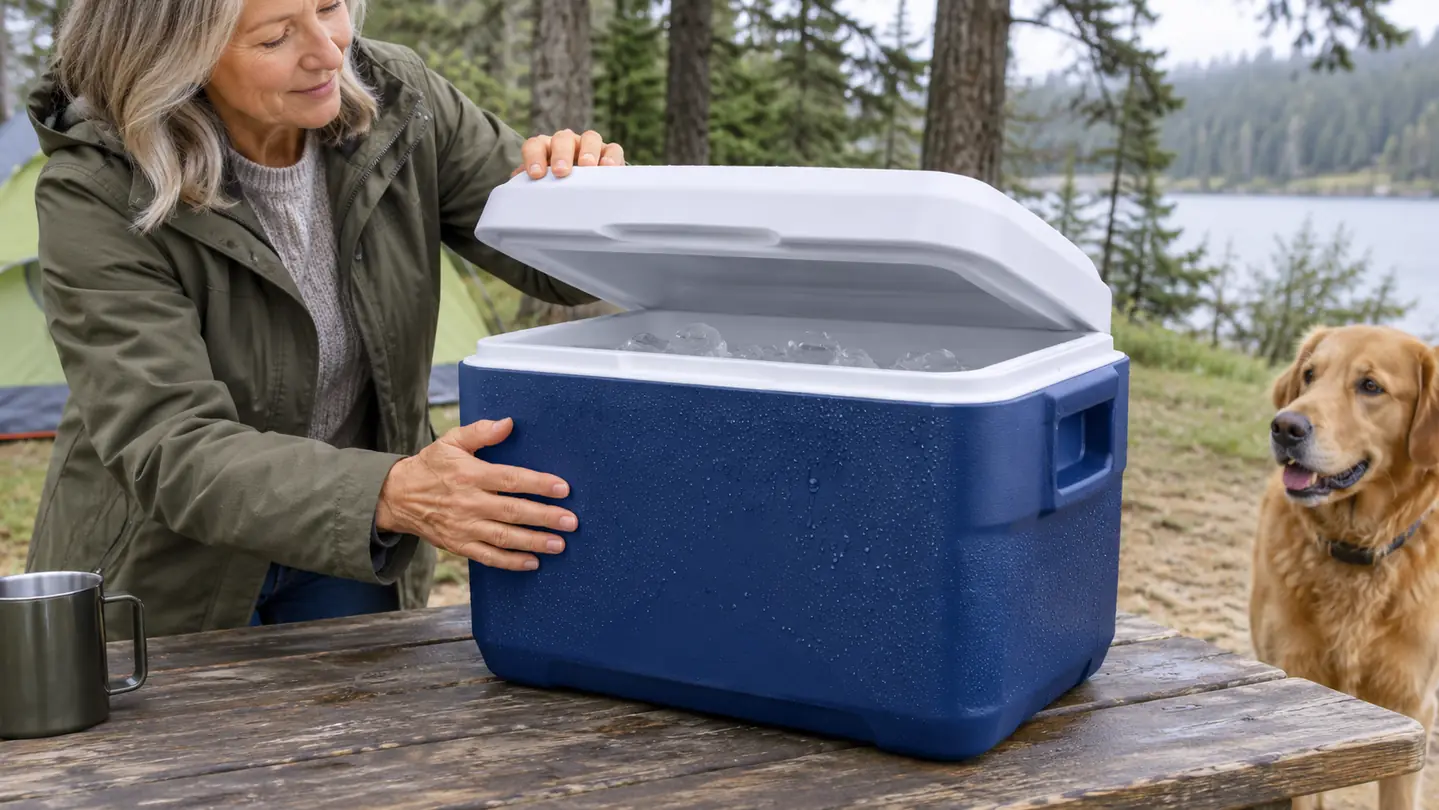
The Trailmate's headline claim is extra-thick 1.5-inch foam-insulated walls and an insulated lid. This is the part that matters and the part I can speak to directly, because I came from a thin-walled cooler that turned a bag of ice into lukewarm water by Sunday morning.
On our July trip, with highs around 88 and the cooler sitting in shade under the hatch of the car, I started with two bags of ice Friday at 4 p.m. and still had solid ice Sunday at noon. Not a full bag. But real cubes, not slush. I drained water twice over the weekend, which is normal and not a defect, and the food stayed cold enough that I was comfortable cooking and eating it.
What I will not tell you is that it holds ice for five days. Igloo does not claim that for this model and neither will I. If you are doing a four-night trip in August, plan to buy ice on day three. That is not a knock on the cooler. It is a 50-quart hard cooler with foam walls, not a rotomolded chest with three inches of insulation, and the two are not the same product at different prices.
What I started doing after the July trip was filling the cooler the night before we left. I put the two ice bags in at nine in the evening, closed the lid, and left it in the garage where it stays around 60 degrees. By morning the interior walls had gone good and cold and about a third of the ice had already melted into water. That sounds like a loss. It is not. The next two days went noticeably better than the same load did the trip before, and I stopped being able to see daylight between the good and bad weekends. The one that went worst, back in June, was the one where I dumped warm ice into a room-temperature cooler at 8 a.m. and drove off immediately. Same cooler, same food, worse result, and the difference was entirely in how I started it.
One thing I did notice: the Cool Riser Technology, which lifts the cooler body slightly off whatever surface it is sitting on, seems to matter more than I expected. When we left it directly on sun-warmed pavement at the picnic area, it did noticeably worse than when it sat on the shaded gravel pad. Whether that is the riser or just physics, the practical takeaway is the same: keep it off hot ground and out of direct sun and you get closer to the good end of its range.
Two bags of ice Friday at 4 p.m., solid cubes still there Sunday at noon, highs around 88. That is the honest number. Not five days.
The Lid Is the Weak Point
This is the part I would want someone to tell me. The lid latches, and it latches fine, but it does not have the rubber gasket and the heavy compression of a premium chest. On a hot day, with the cooler in the sun and the lid opened four or five times for drinks, I can feel the difference. The cold air sits low and comes out every time you open it, and the lid does not fight that as hard as I would like.
Practically, this means two habits. First, keep the drinks in a separate small bag or in the bottom of the cooler so you are not opening the big lid every twenty minutes. Second, do not store the cooler in the sun and expect the lid to compensate. It will not.
The other habit I picked up is a fifteen-second check before I close it. I run the flat of my hand along the rim and feel for the grit that gravel sites leave behind, because a single grain of sand on that rim holds the lid up just enough to matter, and you will not see it. The first time I found one, I had been blaming the lid all weekend for ice loss that was my own fault. A paper towel and a little water fixes it. On a hard cooler this is the whole maintenance routine, and it is worth doing at the start of every trip rather than the end.
I also want to be honest about the seal over time. Ours is one season old and still seating properly, but I have looked at the hinge and the latch hardware and I can see how a few years of being dropped on a tailgate would loosen things up. The warranty covers defects in material or workmanship under normal use, which is a fair warranty and also the kind of warranty that does not cover a hinge you bent yourself.
Living With It in a Subaru Outback
Here is where the Trailmate and I have our disagreements. The exterior is 18 inches deep, 25.7 inches wide and 16.7 inches tall, and it weighs 15.4 pounds empty. Fifteen pounds empty sounds light. It is light. But loaded, with ice and food, you are lifting forty-plus pounds, and the footprint is the real issue.
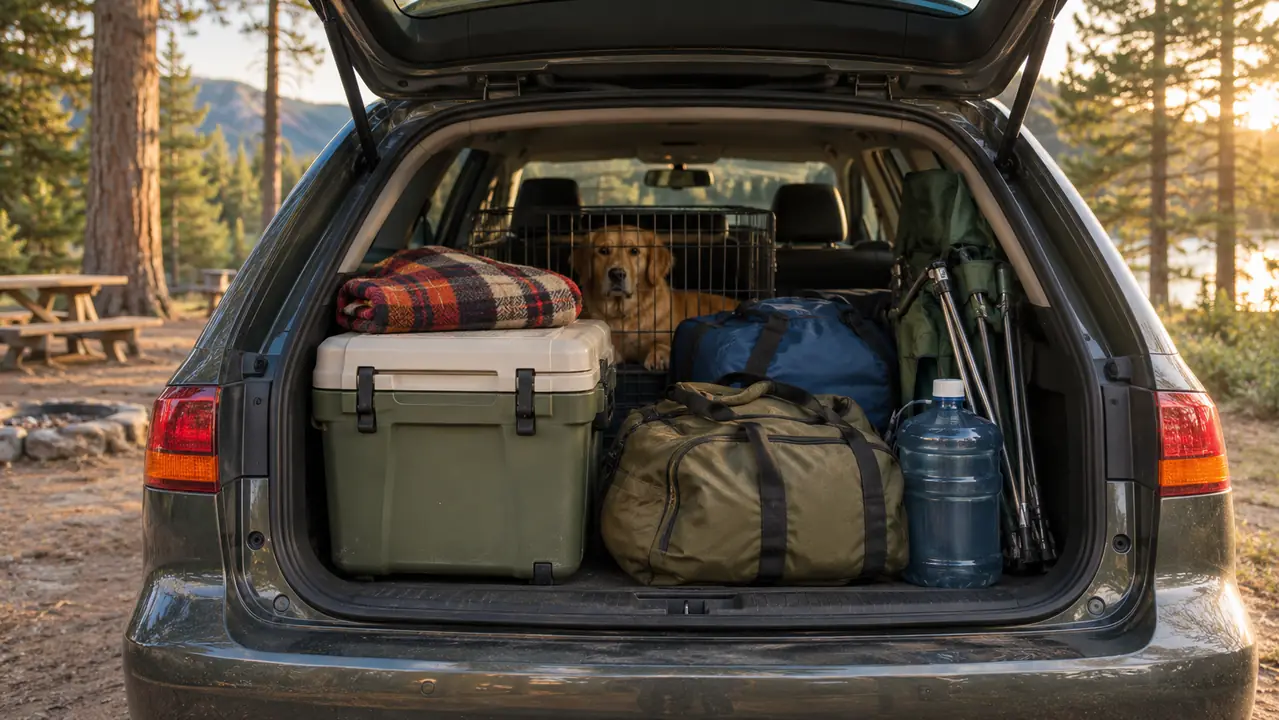
In the Outback, with a dog crate on one side, the cooler eats most of the remaining floor. It fits. It fits fine. But it fits in a way that means the camp chairs have to go on top of something else, and the water jug has to ride in the back seat footwell, and I have to think about the packing order before I start loading instead of just throwing things in.
What finally worked, after two summers of fighting this, was a loading order I now do the same way every time. Dog crate goes in first, passenger side, pushed all the way to the seat back. The cooler goes in behind the driver's seat, lengthwise, with the long side against the seat back and the hatch-side handle facing out so I can grab it. Duffels fill the gap between the crate and the cooler. The camp chairs lie flat on top of the duffels, not under them. The water jug goes in the footwell behind Glenn. That arrangement takes about four minutes and it took me most of one season to arrive at it, mostly by getting it wrong at a rainy trailhead while the dog whined in the front seat. If your vehicle is bigger than an Outback, none of this applies to you and I envy you.
For a sedan or a small crossover, I would measure your cargo opening before you order. Twenty-five and a half inches wide is not enormous, but it is wider than the narrowest part of a lot of hatch openings, and the cooler has to go in level because of the ice.
The side handles are the best part of the exterior design. They are wide with a reinforced crossbar and a diamond-textured grip, and Glenn and I can carry it together without either of us having to set it down halfway. I have carried it solo from the car to the site, maybe forty yards, and it was manageable but not something I would want to do over uneven ground with a full load. The one time I tried it further, at a walk-in site in the Olympics where the parking lot sits at the top of a gravel ramp, I got about sixty yards before I set it down and wished I had brought the little folding cart. That is not a knock on the handles. It is a 50-quart cooler full of ice, and there is a limit to what handles can do about that.
The 50-quart Trailmate fits a hatchback if you measure first
18 x 25.7 x 16.7 inches outside, 15.4 pounds empty, 81 cans of stated capacity. See the current price and the full spec sheet on Amazon.
Amazon See It on Amazon →What Nobody Tells You About Hard Coolers at This Size
A 50-quart hard cooler is a commitment. It is not the cooler you grab for a picnic and forget in the car. It is a piece of equipment that has to be emptied, drained, wiped out and dried with the lid open in the garage, or it will smell like a pond by August.
I dry ours upside down on two sawn-off two-by-fours in the garage, lid propped, for a full day after every trip. That is not an Igloo problem. That is a hard cooler problem, and it is the reason people buy soft coolers and then complain that soft coolers do not hold ice.
The other thing nobody tells you: hard coolers at this size are heavier than the marketing implies, and the weight is in the walls, not the shell. Every pound of foam that keeps your ice solid is a pound you lift. The Trailmate's 1.5-inch walls are why it works and why it is annoying, and you cannot separate those two facts.
Odds and ends from the season: the drain plug is a standard screw type and it works, though I would not want to lose it because it is not the kind of thing you find at a state park camp store. The interior is a plain hard liner with no basket and no divider, so everything slides around a bit when you carry it. I sorted that with two small plastic bins from the kitchen, which is a five dollar fix and I should not have to do it. The exterior has picked up a few scuffs from gravel and one long scratch from a tailgate, and none of it has affected anything. The letter print pattern on the side has not faded or peeled, which I mention only because I have had decals on other gear flake off in a single season in the sun.
Where It Beats the Soft Cooler We Used to Bring
We brought a soft cooler for three seasons before this one, and the honest comparison is not close on ice retention. The soft cooler was fine for a day trip with drinks. It was not fine for two nights of real food. By Sunday morning the soft cooler was a bag of water with some cold cans in it.
The Trailmate also wins on the dog. Juniper has stood on it, jumped off it, and scratched at the lid with a wet paw, and the hard shell has shrugged all of it off. The soft cooler did not survive a summer of the same treatment. The lining tore at a seam near the zipper in August of the third season, and I sewed it once and then stopped bothering, because by then I had already decided to replace it.
Where the soft cooler wins, and I will say so plainly, is storage and carrying. It folds flat in the garage. It weighs almost nothing. It goes in the footwell. If your camping is one-night drive-ins with drinks and sandwiches, the Trailmate is more cooler than you need, and you will resent the footprint.
Who This Is For
The Trailmate in the 50-quart size is for the two-to-three-night drive-in camper who brings real food and wants it to stay cold without a resupply run. It is for someone with a vehicle large enough to give it a dedicated corner, and someone willing to dry it out properly after each trip.
It also suits families, because 50 quarts with 81 cans of stated capacity is a real amount of volume, and the wide handles mean two people can move it. And it suits anyone who has gotten tired of a soft cooler turning to soup by day two.
Who Should Skip It
Skip it if you are camping out of a small car, if you are carrying the cooler more than forty or fifty yards to a site, or if your trips are single nights with drinks only. A smaller cooler or a decent soft cooler is the better tool and you will be happier.
Skip it if you expect five days of ice in August. That is a different class of cooler and a different class of money, and buying this one expecting that will make you one of the reviewers who gives it two stars for a promise Igloo never made.
And skip it if you know yourself well enough to know you will not dry it out. A cooler that sits closed and damp between trips is a cooler you will throw away in three years, and that has nothing to do with the brand on the lid.
What I Liked
- 1.5-inch foam walls and an insulated lid genuinely hold ice through a hot weekend
- Wide reinforced side handles let two people carry it comfortably
- Hard shell takes dog claws, tailgate drops and gravel without marking
- 50-quart size holds real food for two or three nights, not just drinks
- Cool Riser design does seem to help when it is off hot pavement
Where It Falls Short
- Lid does not seal as tightly as a premium chest, so keep cold-air loss in mind
- At 18 x 25.7 x 16.7 inches it claims a serious chunk of a small cargo area
- 15.4 pounds empty, considerably more loaded, and it is not a one-hand carry
- No interior basket or divider, so contents slide around
- Needs a full dry-out after every trip or it will hold a smell
What I'd Tell You If We Were Sitting at My Kitchen Table
If you are camping two nights at a time with real food and you have a vehicle with room, the Igloo Trailmate does the job and does it well. The foam walls are not marketing. I have the ice to prove it.
If you are camping one night with drinks, buy something smaller and save your cargo space. And whatever you buy, budget for a bag of ice on day three of any summer trip, because no cooler in this size class is going to save you from that.
Check the current price on the 50-quart Trailmate
4.6 stars from 643 ratings. Made in the USA with USA and imported parts, 1.5-inch foam walls, wide two-person handles. If the size fits your car, it will fit your weekend.
Amazon Check Today's Price on Amazon →