
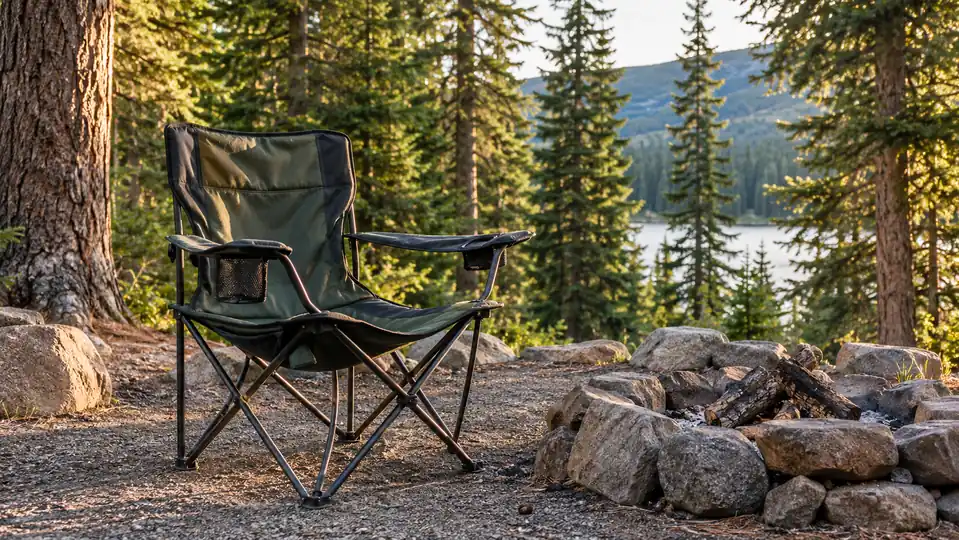
The first time I spent a whole evening in a cheap folding camp chair, I knew within four minutes. Not a sharp pain, just a slow complaint starting at my belt line and working its way up. By the time Glenn had the fire going I was shifting my weight every thirty seconds and pretending to admire the view. The chair was not broken. It simply was not built for a back like mine, and no amount of adjusting was going to change that.
Most camp chairs are designed to be light and inexpensive to make. That is a reasonable goal for a manufacturer and a poor match for a spine with opinions. If your back starts talking after twenty minutes, the answer is not a cushion wedged behind your lumbar curve. The answer is choosing the right chair before you drive out. We have gone through half a dozen in ten years of weekend camping, and the one that now lives permanently in the back of our Outback is a Coleman Portable Camping Chair with the cooler built into the arm. I will use it as the worked example for the rest of this piece, not because it is the only decent chair made, but because it lets me point at real numbers instead of adjectives.
The chair that ended the every-thirty-seconds shuffle
A 24-inch seat, a solid back, a cushioned head rest and a 4-can cooler built into the arm. Rated to support up to 325 pounds. It is the one that stays in our car.
Amazon See today's price on Amazon →Step 1: Start with seat width and seat height
The number that decides whether a camp chair will be comfortable for you is not the frame material and it is not the fabric. It is the seat. A narrow seat pushes your hips together, which tilts your pelvis and makes your lower back do work it should not be doing while you are supposed to be sitting still. The Coleman chair lists a 24-inch seat, with an overall footprint of 40.5 inches deep by 24 inches wide by 37 inches high. Twenty-four inches is enough that I can sit with my feet slightly apart and my knees falling outward instead of pinching together, which is the single biggest difference between a chair I can sit in for an evening and one I cannot.
Seat height is the second number, and almost nobody checks it. A chair that sits low forces you to stand up out of it with your knees. If your back is already cranky, that push is where you feel it, and you feel it every single time you get up for anything. Before you buy, sit in the camp chair you already own and notice whether you push off with your thighs or haul yourself up with your arms. If it is your arms, you want a chair with a firmer sitting position and armrests you can press down on. That is the whole test. It takes ten seconds and it tells you more than any review, including this one.
One practical note from someone who has made this mistake twice: do not shop for a camp chair while picturing the chair you had in 1998. Sit in whatever is in your garage right now, note how it actually feels at minute fifteen, and put a tape measure across the seat. Then compare that number to whatever you are thinking about buying. Twenty-four inches sounds abstract until you lay a tape across the chair in front of you and see how much of that width you actually get.
Step 2: Decide what you want the armrests to hold
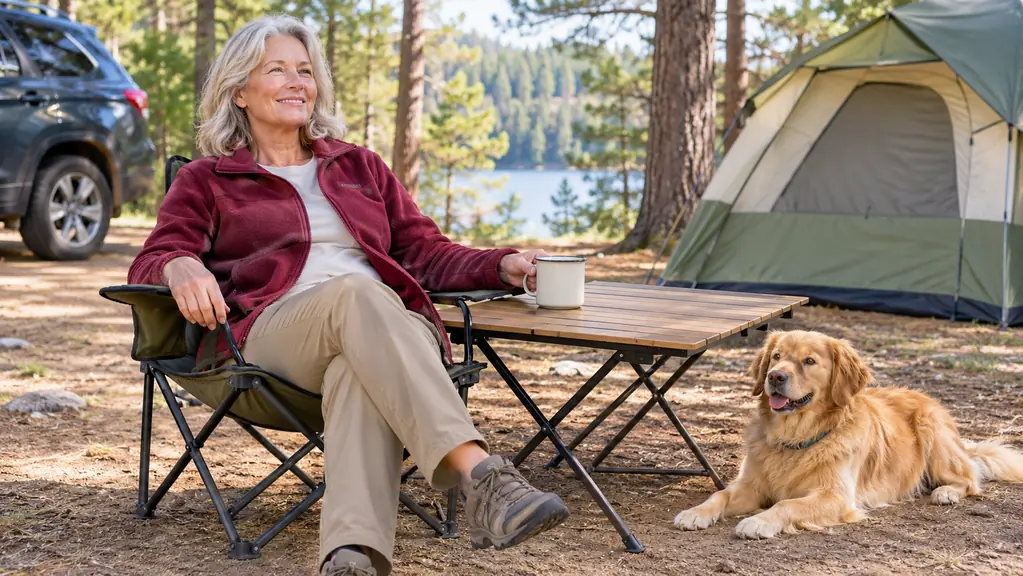
Armrests on a camp chair do two jobs. They give you something to push against when you stand up, and they hold things. For most of my life I thought of them as the first job only. My hands are usually holding a mug, a book, or a dog leash, so the holding matters more than I would have admitted at forty.
The Coleman chair puts a small cooler in one arm that holds four cans, plus a mesh cup holder, plus side pockets for the small stuff. The cooler is the feature people ask about. The cup holder is the feature people actually use, in my experience. A mesh holder keeps a travel mug upright and within reach, which sounds trivial until you have set a mug down on the ground, turned to say something to your husband, and then completely lost track of where the ground was.
Be realistic about what an armrest cooler is. It holds four cans. It is not a refrigerator, and it will not keep anything cold through a hot afternoon in August. What it does is save you standing up and walking to the cooler every time you want a cold drink. For a back that dislikes standing up out of a low chair, that is not a small thing. Count how many times you get up in an evening. Multiply it by the number of evenings you camp in a season. That is the argument, and it is a better argument than any description of the fabric.
Step 3: Check the back and the head rest against your own spine
A camp chair back has one job, which is to give your spine something to lean against rather than something to hold up. The Coleman chair has a solid back rather than a sling, and a solid back is what I look for now. A sling curves where the fabric decides to curve, and where it decides to curve is rarely where you wanted it. A solid back keeps its shape, so your shoulders end up roughly where the manufacturer intended them to be, and your lower back gets a flat surface instead of a hammock.
The cushioned head rest is the part I ignored for years and now notice immediately. If you read in your chair, or if you lean back to watch the fire, your head has to go somewhere. Without support, your neck does the work your back was hoping to hand off, and by nine o'clock you are stiff in a completely different place than you expected. With support, an hour of reading is possible instead of fifteen minutes.
There is a limit to what any folding chair can do, and I want to be honest about it. This is a camp chair, not a recliner and not a piece of therapy equipment. If your back is in a bad stretch, no chair fixes it and you should see someone about it. What a good chair does is stop adding to the problem at the end of a day when you are already tired. That is a lower bar than the marketing suggests, and it is still worth choosing carefully.
Step 4: Weigh the chair against the walk from the car
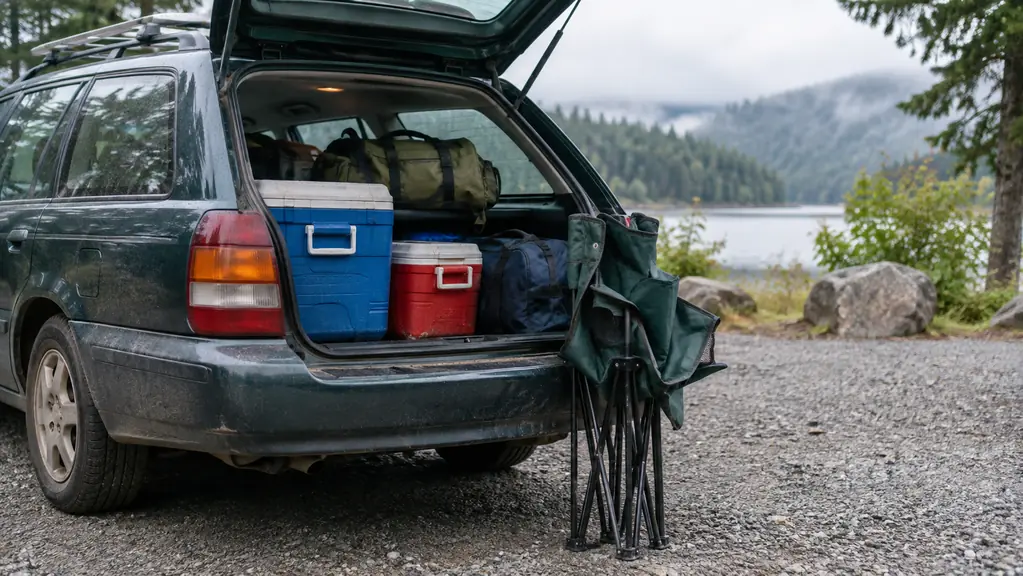
Every camp chair purchase is a trade between comfort and weight, and you have to be honest about which side of that trade you live on. Our camping is drive-in. We park, we walk maybe thirty feet, and we set up. If you are hiking a mile in with a pack, this is the wrong article for you, and you should ignore everything I have said and buy something made of aluminum and air instead.
The Coleman chair weighs 3.5 kg, which is about what a comfortable chair with arms and a cooler built into it should weigh. It is not a chair you carry on your back. It is a chair you carry from the car to the site in one hand while carrying something else in the other, which is exactly how I use it, and it manages that without drama.
It is rated to support up to 325 pounds, and that rating matters even if nobody in your family is anywhere near it. A high weight rating usually means the frame and the fabric were built with some margin, and margin is what keeps a chair from developing a wobble in year three. Glenn is 61 and not a small man, and this chair has not so much as creaked under him in three seasons. That is the kind of thing you only learn by owning one, and it is the reason I stopped shopping around.
Step 5: Read the seams, the pockets and the warranty before you commit
I sew, mostly repairs on gear, so I look at how things are joined before I look at anything else. When a chair arrives, open it in the living room and run your thumb along the seams where the fabric meets the frame at the corners. That is where a chair fails first. If the stitching there looks sparse, or the fabric is already puckered where it wraps the frame, send it back before you take it camping, because a return is much easier from your kitchen than from a campsite forty minutes from the nearest town.
Pockets are the other thing I check. The Coleman chair has side pockets, and side pockets are where the small, annoying objects go: the phone, the headlamp, the loop of the dog's leash, the paperback that is going to get damp anyway. A chair with no pockets means everything ends up on the ground or on someone's lap, and the reaching is what tweaks a back that was doing fine until you needed a tissue.
Read the warranty line too, whatever it says. This chair's listing states no manufacturer warranty, which is worth knowing before you buy rather than after. That does not make it a bad chair, and the build quality is the reason I keep recommending it. It does mean you are relying on the retailer's return window and on your own inspection, so look it over the day it lands on your porch and be less forgiving than you would be with something covered for five years.
What Else Helps
A chair is the largest part of this problem and not the whole of it. What has helped me most over the last few seasons is changing position on purpose. I set a quiet rule for myself and stand up once every half hour, even if I am mid-chapter. It takes twenty seconds, and it means the second half of the evening does not hurt. Glenn finds this amusing right up until the point in the trip where his own back starts in, and then he stands up every half hour too.
A small folding table at elbow height does more for my back than any cushion, because it stops the twisting reach for a mug that is sitting on the ground. We bring a cheap roll-top table and set it between the two chairs. Juniper, our cattle dog mix, immediately lies underneath it, which is the other reason it stays. A mat under the chair helps as well if you are on gravel, since a chair that shifts under you while you are getting up is its own small hazard.
If you want the longer version of how this particular chair has held up across a full season, and how the armchair style compares with a director's chair for sitting through a whole evening, both of those are covered elsewhere on this site. Those are the two questions I get asked most when people see the chair in the back of the car and ask whether it is worth it.
It is rated to 325 pounds and the seat is 24 inches wide. Those two numbers tell you more about whether your back will be happy at hour three than any paragraph about the fabric.
Three seasons in, it is still the chair in the back of the car
24-inch seat, solid back, cushioned head rest, 4-can cooler built into the arm, side pockets, rated to 325 pounds, 3.5 kg. The listing states no manufacturer warranty, so look it over the day it arrives.
Amazon See today's price on Amazon →