
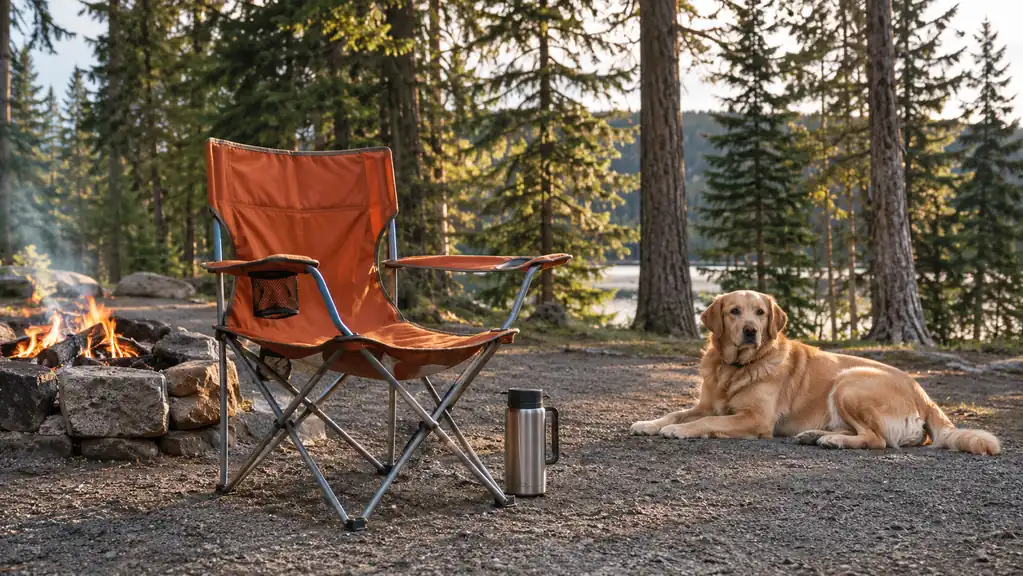
The Coleman Portable Camping Chair with 4-Can Cooler is a chair I bought for reasons that had nothing to do with the cooler. My back had finally objected to the cheap folding stool I had been dragging to state parks since the 1990s, and what I wanted was simple. A real backrest. Arms I could push up from. A seat wide enough that sitting down did not feel like balancing on a fence rail. What I got was a chair that does three jobs well, one job adequately, and one job not at all.
This is not a review that tells you it is wonderful. It is the review I wish I had read before I carried the box to the car. The cooler arm holds four cans and not a lunch. The chair weighs 3.5 kg, which is not heavy in absolute terms but is heavier than the thing it replaced. And Coleman's own listing recommends this chair for hard floor, a detail that matters more than it sounds like it should. I have used it for three camping seasons, April through October, mostly drive-in campgrounds and state parks in the Pacific Northwest, with one longer trip each year. That is enough time to have opinions that are not first-impression opinions.
The Quick Verdict
Comfortable, wide, and steady on gravel, with a cooler that honestly holds four cans and a warranty that holds nothing at all. Buy it for the seat and the back, not for the cooler.
Amazon Check Today's Price →The 24-inch seat is the whole argument, and it holds up
If width and a real backrest are what your current chair is missing, this is the one that stays in my car from April to October. The cooler is a bonus, not the reason.
Amazon See the Coleman chair on Amazon →What Nobody Tells You About the Cooler Arm
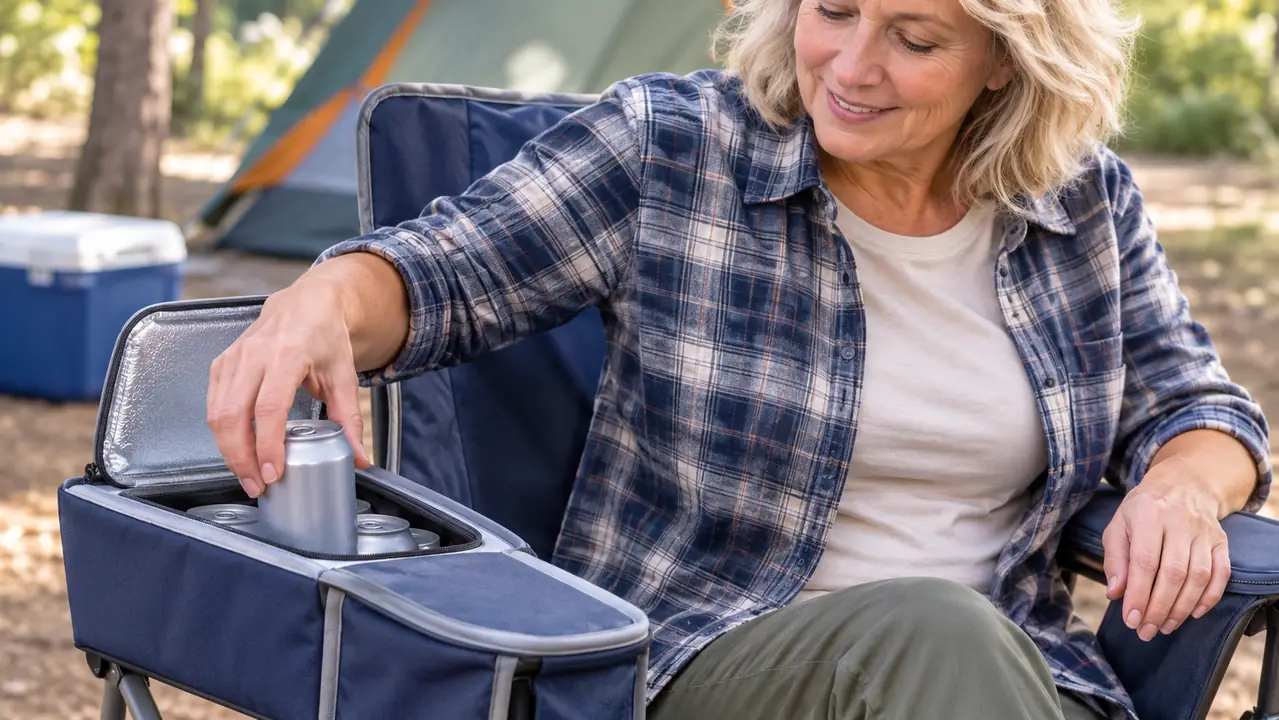
The cooler is the feature on the front of the box, so let us be honest about scale. The listing says four cans, and four cans is exactly what it holds. Not four cans and a sandwich. Not four cans and an ice pack that keeps them cold past the first afternoon. It is a small insulated compartment built into one armrest, and its job is to keep a drink cold for the length of an evening, not to take the place of the cooler in the back of the car.
Within that job it works better than I expected. I load four cans, drop in a handful of ice from Glenn's cooler, and it holds through dinner and the first hour of the fire. In a hot July at a site with no shade, the ice is water by eight in the evening and the last can is cool rather than cold. That is fine by me. It might not be fine by you.
The thing nobody mentions is how it changes the way you get out of the chair. Because the cooler is built into one arm, that arm is a box with a flat lid and the other arm is not. You will not notice this in the store. You notice it on the third evening, when you push yourself up and one hand finds the flat lid of the cooler while the other finds the regular armrest.
There is also a mesh cup holder separate from the cooler, and it is the piece I use most. Coffee in the morning, water at noon, and the cooler stays empty until supper. Two different jobs, and Coleman put both on the same chair, which sounds like marketing until you have spent a weekend setting a mug down on the ground and forgetting where you put it.
Cleaning the cooler compartment is the one chore the chair creates. Cans sweat. Ice melts. Close the lid on a wet compartment, drive home, and open it a week later to a smell you will not enjoy. I rinse it at the sink and leave the lid up to dry, and it has been fine. Twenty seconds of attention once a trip, which is less than the fire takes to light.
Four cans is four cans. The cooler keeps a drink cold for an evening and does not pretend to be the cooler in the car.
How I Have Actually Used It
I camp most weekends from April to October, and the chair lives in the back of a 2017 Subaru Outback alongside a dog who is convinced the cargo area belongs to her. Getting it open takes seconds, which matters more at fifty-eight than it did at forty. I open it, set it down, sit down, and I am done. Glenn has a chair with more pieces and more adjustments, and he is still putting it together while I am three pages into a book.
Where it earns its place is gravel and hard-packed dirt, which is most of what you find at a drive-in site in this state. The listing recommends hard floor, and I understand why after a weekend at a grassy tent site near the coast. On soft ground the legs settle in. It does not tip. It does not fold up under you. But by Sunday the chair sits an inch lower than it did on Friday, and you feel it in your knees when you stand.
Juniper, who is forty-two pounds of cattle dog mix and will not stay off anything soft, has climbed into it more than once. The seat has held. The fabric has held. The only damage in three seasons is a smear of mud on the side pocket that I have not bothered to scrub out, and a small pull in the seam where her claw caught it, which I fixed with a needle and thread in about four minutes.
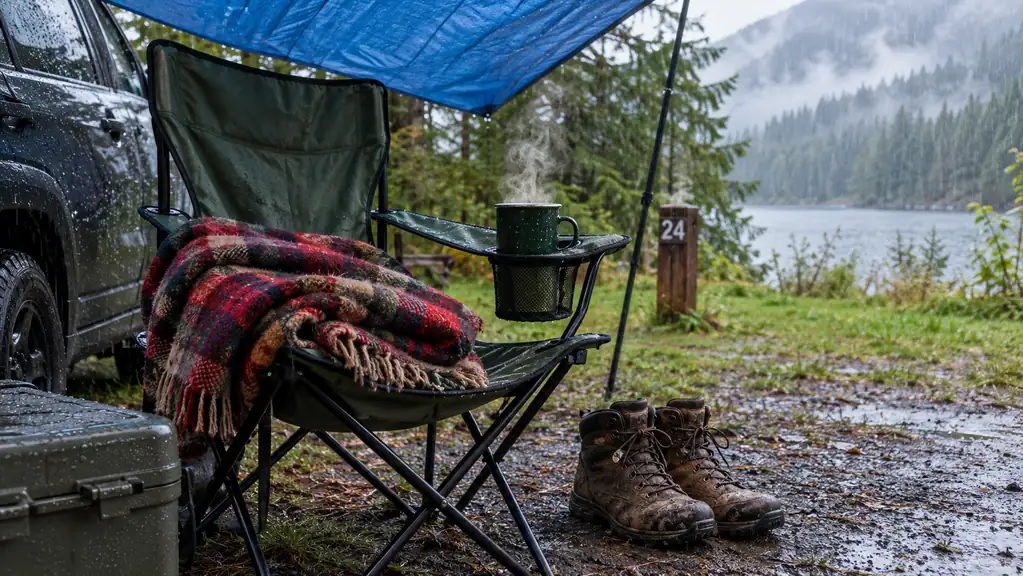
One trip sticks with me. A wet weekend on the Olympic Peninsula, rain sideways, everything we owned damp by Saturday morning. The chair sat under the tarp all day and dried by evening. The side pockets held a paperback that stayed dry because they are deep enough to keep it off the puddle that formed underneath. That is a small thing. Small things are most of camping.
At 325 pounds of rated capacity, this is not a chair a heavier guest has to think about. The frame does not flex and the legs do not splay. I have watched a large friend settle into it for an entire evening without a word of complaint, which from him is high praise.
The Comfort Question: 24 Inches, a Headrest, and Arms That Work
The seat is 24 inches across, and that number is the reason I would buy this chair again. I am not a small person and I have spent years in camp chairs that made me feel like I was sitting in a bucket. This one lets me sit with my arms inside the armrests instead of draped over the edges. If you have ever stood up with a chair stuck to your backside, you know exactly what I am describing, and you know why the width is worth more than the cooler.
The back is solid rather than a sling of straps, and there is a cushioned head rest at the top. I did not think I would use the head rest. I use it constantly, mostly for reading, occasionally for the kind of nap that starts at three in the afternoon and ends with Glenn asking whether I want the fire lit. The back is high enough that my head is supported rather than balanced.
The back is also fixed. It sits at one angle and it stays there, which has suited me for hours of reading and will not suit someone who wants to lean further back as the evening goes on. There is no adjustment to make. You either like the angle or you do not, and there is no finding out until you have sat in it for an hour.
The arms are the part I would change if I could. They are fine for pushing up from, which is the whole point at my age. What they are not is wide enough to hold a plate, and there is no flat surface anywhere on the chair except the lid of the cooler, which is small. Eating dinner in this chair means the plate on your knees. That is true of nearly every camp chair, and I mention it because the cooler arm looks like a table in the photographs and it is not one.
On cold mornings the chair is cold. That is obvious and it still surprised me. There is nothing between you and the morning air, so a blanket goes over the top of you and not under. I mention it only because the head rest makes the chair comfortable enough that you will stay in it longer than you meant to, and staying longer in a cold chair on a forty-degree morning is its own small decision.
What It Weighs and What It Takes Up in the Car
Coleman lists the chair at 3.5 kg, a bit under eight pounds. That is not a heavy chair. It is, however, heavier than the stool it replaced, and if you are carrying it a quarter mile from a parking lot to a walk-in site you will feel it in your shoulder by the second trip. For drive-in camping, which is what I do, the weight is irrelevant. For anything with a walk attached, it is worth knowing before you buy.
The listed dimensions are 40.5 inches deep, 24 inches wide and 37 inches high. That is a full-size chair, not a compact one, and it takes up real room. In the Outback it goes behind the driver's seat, standing, wedged against the back of the seat so it does not slide. It fits. It does not fit invisibly. When we pack for the longer trip each August, the chair is one of the things I plan around rather than toss in at the end.
One more note on the car. Standing behind the driver's seat, the chair does not block the view out the back window, which matters when the rest of the cargo area is dog bed and cooler and firewood. If you drive something smaller than an Outback, measure first. Forty and a half inches is longer than it sounds when you are standing in a driveway holding it.
The listing's included components section says cooler and nothing else. No carry bag. I have been using a canvas sack from a chair that died years ago and it has been fine, but if a bag matters to you, order one with the chair or plan to sew one.
What I Liked
- 24-inch seat is genuinely wide, and the back is solid rather than a strap sling
- Cushioned head rest that I use far more than I expected
- 325-pound capacity with a frame that does not flex or splay
- Four-can cooler keeps a drink cold through dinner
- Mesh cup holder and side pockets handle the small stuff
- Steady on gravel, packed dirt and concrete pads
Where It Falls Short
- No manufacturer warranty listed at all
- Recommended for hard floor, so it settles into soft grass over a weekend
- Cooler holds four cans, no food, and the ice is water by late evening
- 3.5 kg and no carry bag included
- No flat surface anywhere for a plate
Where It Falls Short
The warranty is the thing I most want you to see plainly. The listing's manufacturer warranty description reads, in full, none. Not one year. Not a limited lifetime. None. I have had no trouble with the chair in three seasons, and the frame feels like it will outlast the fabric. But if a weld goes at the wrong moment, you are buying another chair. That is worth weighing against chairs from companies that stand behind theirs, and I would rather tell you now than have you find out at a return counter.
The hard floor recommendation is the second thing. Coleman says hard floor, and my experience matches. On gravel, packed dirt or a concrete pad the chair is solid. On soft grass or sand the legs work their way down over a weekend. It is not a defect. It is a chair designed for the kind of campsite most people actually use. But if you camp on grass more than gravel, expect to reset the chair each morning, and expect your knees to notice by Sunday afternoon.
The side pockets are useful and shallow in a specific way. A phone fits. A paperback fits. A headlamp, a pair of reading glasses, a granola bar, all fine. Anything heavier pulls the pocket out of shape. I would not put a water bottle in one, because the mesh cup holder is where that goes and the pocket will not thank you.
And the cooler really is four cans. If you were picturing a chair that removes the need to walk to the cooler, this is not it. It is a chair that means you do not have to walk to the cooler twice.
Who This Is For
This chair is for the drive-in camper who wants to sit properly. If you are in your forties or beyond, if your back has opinions, if you want arms you can push up from and a seat that does not pinch, the 24-inch width and the solid back are worth the weight and the space in the car. It is also for anyone who camps with a dog, because the seat sits high enough that a wet dog can lie underneath it and the fabric is tough enough to survive being used as a step.
It suits weekend campers who pull in Friday night and sit down. It suits people who read in a chair, which is a specific need and a real one. It suits anyone who has gotten stuck in a camp chair and had to be extracted by a spouse, and anyone who has eaten a plate of dinner off their own knees and decided there had to be something better.
Who Should Skip It
Skip it if you are hiking in. At 3.5 kg and 40.5 inches deep, this is not a chair to carry on your back, and Coleman does not pretend otherwise.
Skip it if you camp mostly on soft grass or sand and want a chair that stays put without being reset every morning. Skip it if a warranty matters to you, because there is not one here. Skip it if you want to lean back further than a fixed angle allows. And skip it if the cooler was the feature that drew you in, because four cans is a modest promise and this chair's real strength is somewhere else entirely.
The seat is the reason. The cooler is the bonus.
Three seasons, one dog, a lot of gravel pads. If the width and the backrest are what your current chair is missing, this is the one that stays in my car from April to October.
Amazon Check availability on Amazon →